June 20, 2007
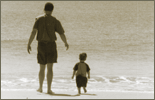
A Son's Tale
My writer friend Darren Defrain recently turned me on to Andre Dubus, and so I've been working through his stories and essays. He has, as another writer friend describes it, a lyrical voice. You can see faith in his stories, along with doubt, and the grit and ugliness in life that makes faith the anchor or buoy or life preserver that it is, but which for some reason too many of us are ashamed to admit about ourselves. Dubus also evokes the question I read once somewhere I can't remember, about why nearly all serious literary figures of Christian faith have been Catholics. Think about it; you're hard pressed to name a significant Protestant writer of prose. I'm not sure why that is, and the question fascinates me.
Last night I read Dubus's essay titled "Digging," from his collection, Meditations from a Movable Chair, which he wrote after being crippled by a reckless driver while helping two disabled motorists. In the essay he describes the hot Louisiana summer of his seventeenth year, when his father got a job for him on a construction site:
I had never done physical work except caddying, pushing a lawn mower, and raking leaves, and I was walking from the car with my father toward workingmen.
Halfway through his first day of helping dig out the foundation, Dubus vomited and nearly passed out. I did not have the strength for this, he wrote, not in my back, my legs, my arms, my shoulders. Certainly not in my soul. Soon his father appeared over the hole where he was digging.
In the car, in a voice softened with pride, he said: 'The foreman called me. He said the Nigras told him you threw up, and didn't eat, and you didn't tell him.'
'That's right,' I said, and shamefully watched the road, and cars with people who seemed free of torment, and let my father believe I was brave, because I was afraid to tell him that I was afraid to tell the foreman.
But his father didn't take him home. Instead he took him to a diner in town, and ordered him a 7-Up for his stomach, and a sandwich. Then they bought a work hat to keep his head cool. And then his father deposited him back at the work site. Despite the arduous work and the dangerous heat, Dubus finished out his summer there. He writes:
It is time to thank my father for wanting me to work and telling me I had to work and getting the job for me and buying me lunch and a pith helmet instead of taking me home to my mother and sister. He may have wanted to take me home. But he knew he must not, and he came tenderly to me. My mother would have been at home that afternoon; if he had taken me to her, she would have given me iced tea and, after my shower, a hot dinner. When my sister came home from work, she would have understood, and told me not to despise myself because I could not work with a pickax and a shovel. And I would have spent the summer at home, nestled in the love of the two women, peering at my father's face, and yearning to be someone I respected...
You should check him out, if you've not already read his work.
Posted by Woodlief on June 20, 2007 at 06:34 AM

What a great story. I own a farm where I hire young men to work. There are certain jobs that are quite hard. I've seen young men almost faint from the exertion. I am in my late 40s, and not in particularly great shape, but I know that I've done this before and survived and thrived from the effort. That knowledge has been a great asset to me in times of trouble. This is knowledge that all men need. You never know what you are capable of until you try.
Posted by: robert kauffman at June 21, 2007 9:04 PM
Tony,
On why serious literary figures seem to be Catholic, I'll offer this.
As a graduate from a Catholic Graduate School, I've seen that Catholicism has not outright rejected classical philosophy. Take Aquinas for example, you can criticize him for efforts to join classical, greek political philosophy with Christianity -- and certainly that can create theological problems. But at least he did not reject it outright. In fact, I would argue the writers of the New Testament epistles tried to use language from Greek religion to help explain the work of Christ.
I have found that most protestant writers seek to reject outright anything that is not explicitly Christian -- be it classical or modern political philosophy or literature -- in favor of attempting a "new creation." In doing so, I believe they miss out on the idea that all men are created "imago dei".
Although all men reject, through sin, that they reflect the image of God, the reflect Him nonetheless. That is what I feel many Christian authors are missing in choosing to only value explicitly "Christian" literature.
As my pastor, whom I consider a wise man, has shared with me, "every story is really the story." Sin and redemption and struggle and sacrifice are reflected in the story of our relationship with our Creator and so reflected in the works we create.
Obviously, these thoughts need to be flushed out more fully. But I've written too much for a comment as it is.
Congratulations on another blessing for your family. I am always please when good parents are gifted with more children.
Posted by: Hinkdog at June 26, 2007 12:32 PM
Post a comment